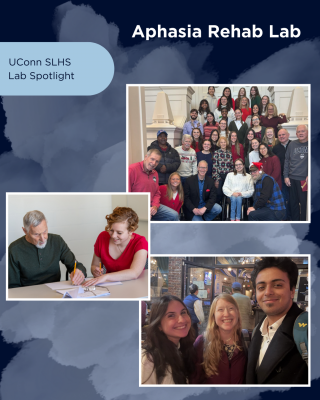
The Aphasia Rehab Lab is directed by Jennifer Mozeiko, PhD, CCC-SLP. The lab focuses on improving treatment for people with aphasia, with the goal of helping them achieve the maximum possible recovery. To do this, the lab thinks about factors like how much treatment is needed and how often it should be administered, for example.
The Aphasia Rehab Lab is currently conducting studies examining communication environments for individuals with aphasia. Since it is known that language practice is critical to language development, the lab seeks to understand the kinds of barriers to practice that a person with aphasia (PWA) may encounter in the home environment. If barriers to practice are identified, speech-language pathologists can provide better guidance to clients. For example, the lab has discovered that there are three main types of environments: 1) One in which there is very little or no communication. 2) One in which families are trying very hard to be helpful and asking things like “what’s this?” and “say that again!” and 3) Ones where communication is more natural. Relating to this, the lab highlights that a more natural environment “takes a little more patience from the family members and a little more persistence from the PWA — but [this type is] the ideal.”
Additionally, the lab facilitates weekly language and book club groups for people with aphasia, promoting language practice and building connections between group members and participating 1st year MA-SLP students. A fun fact is that many of the lab’s research ideas also come from participants in the aphasia groups!
You can follow the Aphasia Rehab Lab on Instagram @uconnaphasialab and Facebook https://www.facebook.com/aphasiarehablab/